
Remember LimeWire? The name probably conjures up images of dodgy MP3s, virus scares, and a chaotic digital wild west of file-sharing back in the early 2000s. Well, brace yourself, because LimeWire is back. But this isn't your older brother's peer-to-peer client. Oh no. The new LimeWire AI Studio has emerged from the digital ashes, reinvented as a generative AI content platform that promises creators not just tools, but legitimate monetization opportunities. Talk about a glow-up.
So, what exactly is this reincarnation? This article will dive deep into LimeWire AI Studio, exploring its AI image generation capabilities, its rather ambitious plans for music and video, and its unique approach to creator monetization through NFTs and ad revenue. We'll also break down the pricing plans and give you our candid take on whether this blast from the past is actually a glimpse into the future of content creation.
Let's be real, the generative AI space is getting crowded. Every week, it feels like a new tool pops up promising to make you the next digital Rembrandt or Beethoven. But LimeWire isn't just another image generator. They're trying to build an entire ecosystem, a place where creators can not only make stuff with AI but actually own, share, and, crucially, earn from it. And that, my friends, is where it gets interesting.

LimeWire AI Studio: The Rebirth of a Controversial Name
It takes guts, or maybe a touch of madness, to re-launch a brand name so historically loaded. LimeWire was, for a generation, synonymous with piracy and legal battles. But the folks behind the new platform aren't shying away; they're leaning into it, transforming the perception from illicit file-sharing to legitimate, decentralized content publishing. It’s an audacious move, and frankly, I'm here for the spectacle.
This isn't just about image generation; it’s positioned as a complete creative publishing platform. You can register, craft AI-generated content (for now, mostly images), and then showcase it on what they call the LimeWire Studio. They've even managed to rope in some actual artists and musicians – think Deadmau5, Soulja Boy, Sean Kingston – who've apparently embraced the platform to publish content as NFT music, videos, and images. That's a pretty big name drop, and it adds a layer of unexpected legitimacy.
But the real hook for many creators? Monetization. LimeWire is throwing several avenues at you: ad revenue, subscriptions, and the ever-present world of Non-Fungible Tokens. For an artist struggling to make ends meet in the digital age, this promise of direct earnings is a powerful siren song. But does it truly deliver?
Diving Deep: AI Image Generation & Creator Features
Let's talk about the actual tools. Right now, the core offering of LimeWire AI Studio is its image generation capability. And they're not skimping on the backend. We're talking support for advanced models like Stable Diffusion 2.1, Stable Diffusion XL, and DALL-E 2. That's a solid foundation, putting them right up there with many dedicated AI art platforms.
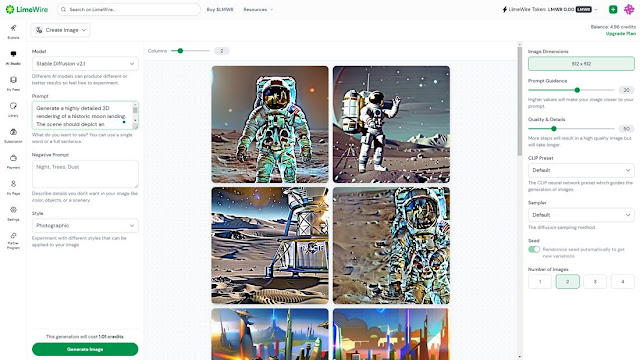
Like other generative AI tools, you can start with a simple text prompt or get as detailed as your heart desires. But where LimeWire tries to differentiate itself is in the sheer flexibility of styles. You can effortlessly switch between cinematic, digital art, pixel art, anime, analog film, and more. Each style gives your AI art a completely different vibe, which is great for experimentation. They also include samplers for fine-tuning, customization options, and prompt guidance – all the bells and whistles you'd expect from a polished AI art platform.
And here's a kicker: they're actively developing their own proprietary AI model. That signals a serious long-term commitment, not just a quick cash grab. It implies they want to push the boundaries, which is always exciting for creators. They're also planning to expand into AI music and video generation, which, if executed well, could be a genuine game-changer, especially given the monetization angle.
Monetization & The Token Economy: Is It a Creator's Paradise?
This is where LimeWire really carves out its niche. They aren't just giving you tools; they're offering a path to revenue. Let's break it down.
Minting Magic: NFTs Made Easy

After you've whipped up your masterpiece, LimeWire offers an intriguing option: automatically minting your creation as an NFT. This happens on either the Polygon or Algorand blockchain, imbuing your digital art with that unique, verifiable digital signature. Suddenly, your AI-generated image isn't just an image; it's an ownable, tradable asset.
Creators get to decide how exclusive their NFTs are. You can make them public, letting anyone discover and trade them, fostering a community around your art. Or, you can reserve them for premium subscribers, offering exclusive digital collectibles to your most dedicated fans. And get this: creators earn a 2.5% royalty every single time their content is traded. That's a passive income stream, however small, that many artists would kill for. It’s certainly more than you get from a simple social media post.
"The push towards automated NFT minting and creator royalties, while still nascent, represents a significant shift. It's an attempt to embed intrinsic value directly into digital content, a potential democratizing force for artists who often feel exploited by traditional platforms." - Dr. Evelyn Reed, Digital Economy Strategist
Ad Revenue Sharing & The LMWR Token: A Crypto Twist
Beyond NFTs, LimeWire promises a share of ad revenue. When you publish content, you receive a whopping 70% of the ad revenue generated from users viewing your images, and soon, music and videos. This is a pretty aggressive revenue split in favor of creators, especially compared to some legacy platforms. For designers and artists just starting out, it could be a nice side hustle, a way to earn a little something for experimenting and sharing their work.
Now, about that revenue: it comes in the form of LMWR tokens, LimeWire's very own cryptocurrency. Your earnings are paid monthly in LMWR, which you can then trade on major crypto exchanges like Kraken or ByBit. You can also use these tokens to pay for prompts within the LimeWire generative AI tools, creating a closed-loop economy. It's a bold move, tying their creator economy directly to a crypto asset, and it certainly keeps things interesting.
Pricing It Out: What Does LimeWire AI Studio Cost?
You can actually get started with LimeWire AI Studio for free. They give you 10 credits to play with, which is enough for about 20 AI image generations per day. Plus, you still get a 50% ad revenue share on the free tier. That's a pretty generous entry point, letting you kick the tires before committing any cash.
But if you're serious about creating, their premium plans offer more bang for your buck:
- Basic Plan: For $9.99/month, you get 1,000 credits (up to 2,000 image generations), early access to new AI models, and that 50% ad revenue share.
- Advanced Plan: Step up to $29/month, and you'll snag 3,750 credits (7,500 image generations), early access, and a bump to a 60% ad revenue share.
- Pro Plan: At $49/month, they give you 5,000 credits (10,000 image generations), early access, and the top-tier 70% ad revenue share.
- Pro Plus Plan: The big kahuna at $99/month, delivering a massive 11,250 credits (22,500 image generations), early access, and still that sweet 70% ad revenue share.
All premium plans throw in a 'Pro' profile badge, full creation history, faster image generation, and a blissful ad-free experience. For a professional, or even a serious hobbyist, the higher tiers offer a compelling value proposition, especially if those ad revenue and NFT royalties start to add up. Compared to some other AI platforms, the credit-to-generation ratio seems competitive.
The Verdict: Is LimeWire Back in a Big Way?
Look, the new LimeWire is an intriguing proposition. It's not just another generative AI tool; it’s an ambitious attempt to build a self-sustaining ecosystem for creators, melding AI generation with blockchain ownership and direct monetization. The audacity of reusing the LimeWire name is matched only by the scope of their vision.
It's genuinely democratizing in its approach, providing accessible AI tools and real avenues for earning, potentially bypassing the gatekeepers of traditional content platforms. The planned expansion into AI music and video generation is a bold move that could truly solidify its position as a multi-modal creator hub. For anyone dabbling in digital art or looking for new ways to monetize their creative output, LimeWire AI Studio definitely warrants a closer look.
Will it succeed in shedding its controversial past and becoming a legitimate powerhouse in the creator economy? Only time will tell. But for now, they've certainly got our attention here at Technify, and we'll be watching to see how this resurrected phoenix takes flight.
Discussion
Loading comments...